
Lake Monticello Water and Wastewater Systems
Aqua Virginia has had the honor of serving Lake Monticello and surrounding communities since 2003. Our water and wastewater systems are relied on to bring safe, reliable water to local residents – and our team takes that responsibility very seriously.
Aqua Virginia has been working with the team at Lake Monticello Owners Association (LMOA) and their water workgroup to increase communications between Aqua and your community. Our goal is to share information about what is happening in our water and wastewater systems to keep you up to date on important information, new projects, routine maintenance activities, and how we can work together to protect our water and natural resources.
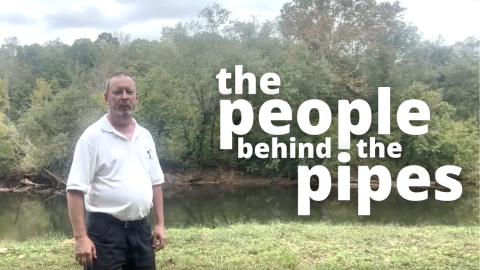
Learn more about Aqua Virginia's award-winning Lake Monticello Water Treatment Facility:
Press Release: Aqua Virginia Earns 20th Consecutive State Excellence Award for Water Quality Performance
Video: Click here or image below to watch
You can find more on Aqua’s activities in your community below.
Our water system is providing safe drinking water that meets state permit requirements, and our wastewater treatment plant is compliant with state requirements and effectively protecting the Chesapeake Bay watershed.
In the summer of 2023, we experienced several Sanitary Sewer Overflows (SSOs), which prompted our review of both our operations and the customer connections supplying our wastewater flow. From that we identified areas where we can proactively improve our system, and have taken action on them:
- Enhanced our monitoring through remote monitoring and smart cover installation
- Enhanced our collection system maintenance with the purchase of equipment to provide more frequent maintenance and faster emergency response
- Studying our capacity and expanding our wastewater treatment plant
- Launched our Grease Trap Inspection Program and taking necessary action when we find commercial customers are not in compliance with program rules
We’re also asking our customers to make sure they’re not putting our system at risk for SSOs – there are small changes to behaviors that can make a big difference:
- Keep fats, oils, grease from going down your sink drain and only flush toilet paper down the toilet
- Do not flush diapers, rags and wipes – even if they say that they are flushable
- Do not dispose of trash, pet waste, or dirty diapers on the beach and areas in and around the lake or near storm drains
- For public and commercial food service establishments, follow our Grease Trap Inspection Program protocols
- You can find much more in the sections linked below
Additional System Information
Lake Monticello at a Glance
Find out about the infrastructure in Lake Monticello’s systems here.
What areas does Aqua Serve?
Our water and wastewater systems provide water to a small regional area around the Lake Monticello Community. Areas included in the Lake Monticello Owners Association (LMOA) that are shown in blue and the surrounding areas that are shown in orange that could be served by Aqua as part of a new or existing development approved by Fluvanna County.

How does Aqua address new development in our Water and Wastewater system?
Lake Monticello is part of the Rivanna Community Planning Area and only a portion of this planning area is served by Aqua Virginia. The Fluvanna County Planning and Zoning Department’s responsibilities include current planning, long range planning, and code enforcement. Aqua participates in the county’s Technical Review Committee (TRC) to determine if new projects can be served by Aqua. As a new project moves forward Aqua’s engineers work with the developer to determine if new infrastructure must be installed by the developer to mitigate impacts to the existing system.
Find out more about new development in Fluvanna County here.
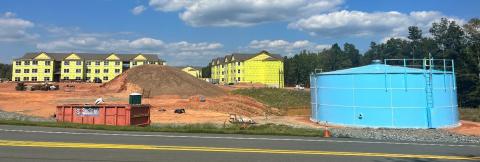
Water System Information
Water Infrastructure Highlights
- 1.38 mgd Regional Water Treatment Plant
- Almost 5,500 water & wastewater connections
- 3 ground storage tanks
- 76 miles of water main
Water Plant Intake Modification
- Overview: Construct a new intake structure in the Rivanna River, a control building, pump station and associated pipe infrastructure to help increase capacity and water plant efficiency.
- Status: In process, contractor has been selected, permits have been received and construction planned to start in early July.
Cherokee Subdivision (Section 10) Transmission Main
- Overview: Design of upgraded transmission lines to increase capacity of the water main.
- Status: Completed in May 2026
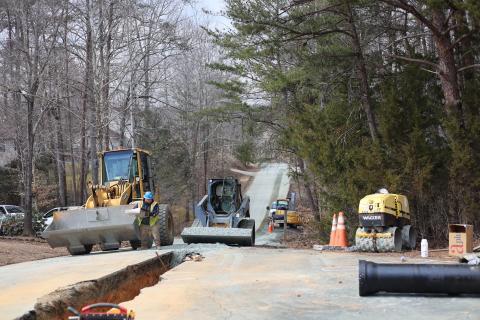
Water Storage Tank Repair
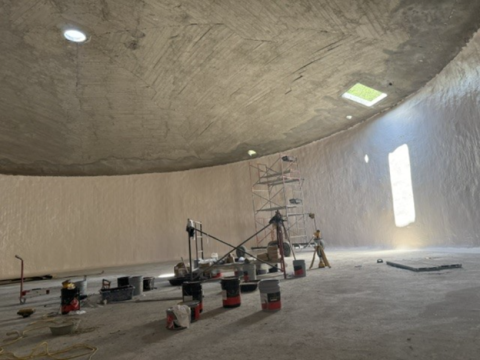
- Overview: Planned repair and maintenance work on our 750,000-gallon water tank. Work includes cleaning and painting the inside and outside of the tank and making other repairs as needed.
- Status: In progress, repairs completed and anticipated to be back in service in mid-July.
Elevated Water Storage Tank Study
- Overview: Study evaluating a future elevated water storage tank to provide additional domestic pressure and fire flow capacity. The feasibility study will provide a path forward for actual design and construction of an elevated storage tank.
- Status: Study is underway, our design consultants are coordinating with Aqua on hydraulic model data and potential site locations. Design has extended into 2026
Future Project Development
- Additional hydraulic modeling (tank sizing and evaluations) and review of waterline break data to identify potential waterline replacements.
- Implement study recommendations.
- Preparation of a Preliminary Engineering Report.
Wastewater System Information
Wastewater Infrastructure Highlights
- 0.775 MGD Regional Wastewater Reclamation Facility
- 54 Lift Stations
- 3K Manholes
- 1K Grinder Pumps
- 39+ Miles of Force Main
- 116+ Miles of Gravity Sewer Lines
- In 2023, Aqua completed approximately 2.5 miles of collection system rehabilitation as part of its Water and Wastewater Infrastructure Service Charge (WWISC) projects.
Current Projects
Enhanced Remote Monitoring at Lift Stations
- Overview: Upgrading SCADA remote monitoring on lift stations.
- Status: Remote monitoring upgrades are planned for seven lift stations in 2026. Aqua has already upgraded 22 lift stations with SCADA systems as of October 2023.
- The SCADA Control Panels installed to date monitor critical pump data, high sewage wet well status, lift station status, and alarm notification. Staff have been able to respond in time to resolve issues after several high wet well alarms, and no overflows have occurred at any of these sites.
- Schedule: Ongoing
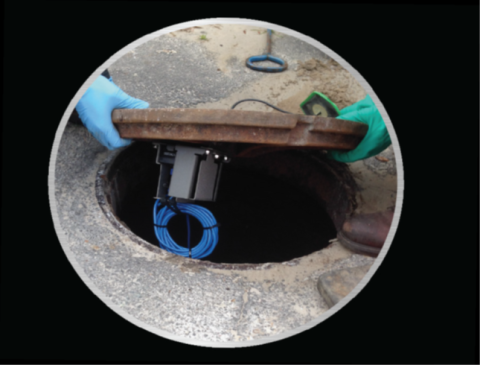
Remote Monitoring with Smart Covers
- Overview: Installation Smart Covers to monitor the wastewater collection system.
- Protect the Environment by:
- Utilizing real-time alarms to dispatch crews before over-flows occur.
- Eliminating environmental and community impacts associated with sewer spills.
- Identifying locations with capacity constraints to prevent future overflows.
- Status: Completed,18 Smart Covers installed to date and additional smart covers will be added as needed.
Odor Mitigation Projects
- Odor Study:
- Overview: Evaluate existing wastewater odor, Identification of potential projects to reduce wastewater odor.
- Status: Completed, Odor study identified potential mitigation projects to implement throughout the Lake Monticello Wastewater Collections System.
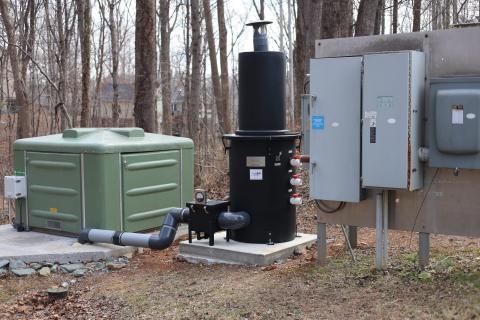
- Air Scrubber Pilot Projects
- Overview: Aqua completed the installation of an Air Scrubber, a specialized piece of equipment designed to remove hydrogen sulfide (H₂S) gas from air. This device has been permanently installed on a small concrete pad at the existing Beach 5 lift station. Aqua plans to evaluate the effectiveness of this pilot project before moving forward with installation of a similar device at the Glen Burney lift station.
- Status: Construction completed and monitoring is underway
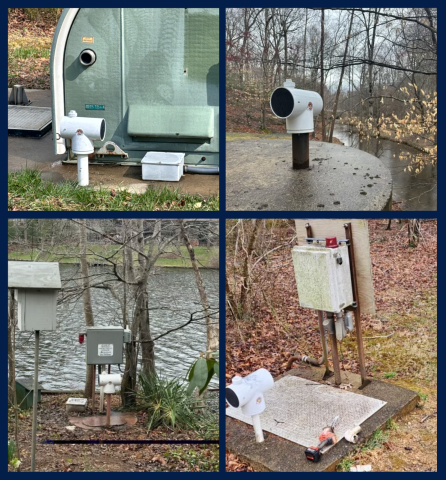
- Lift Station Vent Filters
- Overview: Install active carbon filters on lift station vents to help reduce odor throughout the community.
- Status: Activated carbon filters have been installed on all Lift station vents in the collection system. Aqua will continue to maintain the carbon filters as needed.
Sewer Conveyance Capacity Study
- Overview: Evaluate existing wastewater conveyance capacity, mostly between Colonial Circle and the WWTP and identify future projects to increase capacity as needed. This study should identify areas for capacity related upgrades (sewer lines, manholes, pump stations.)
- Status: In process
Wastewater Treatment Plant Expansion
- Overview: Modify the wastewater treatment plant headworks to increase plant efficiency.
- Status: Contractor selection is underway, construction planned to start in 2026.
Current Lift Station Upgrade and Replacement Projects
- 502 Lift Station
- 503 Lift Station
- Amethyst Lift Station
- Landslide Lift Station
Competed Lift Station Upgrade and Replacement Projects
- 302 Jefferson /Forest
- Beach 5 Lift Station
- Brassey Lift Station
- Clubhouse Lift Station
- Kingswood Lift Station
- Mechunk Lift Station
- Marwood Lift Station
- Mesquite Lift Station
- Out of Bounds Lift Station
- Riverside Lift Station
- South Bearwood 400116933
Inflow and Infiltration (I&I) project
- Overview: Rehabilitation project to inspect and repair areas were groundwater and/or surface water can or has been getting into the wastewater system. Reduction of sewer flow from I&I that could damage infrastructure and result in higher treatment costs. This I&I program will continue with future I&I reduction projects at Lake Monticello on an ongoing basis.
- Status: Ongoing, cleanout work will take place in June 2026.
Stream Crossing Inspections
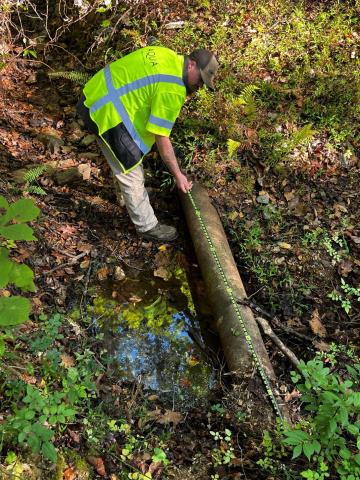
- Overview: Visual field inspection of over 100 sanitary sewer outfall locations with stream crossings.
- Status: 2025 Completed
- Schedule: 2026 inspections will start in Q4 2026
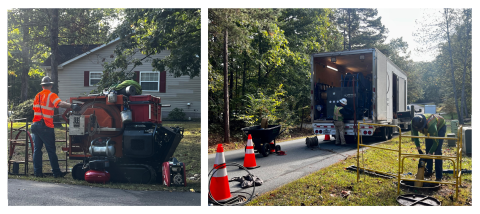
Operation & Maintenance (O&M) Equipment
- Overview: Purchase of a Jetter Trailer and purchase a Vacuum Tank to replace the need for a third-party vendor for routine operation and maintenance.
- Status: Delivered
- Schedule: Completed
Future Project Development
- Upgrade WWTP pretreatment units
- Continued SCADA implementation
- Implement study recommendations
Help Protect Your Water and Wastewater Systems
Protecting Your Water System
Protecting Your Water System from Winter Weather
Winter weather and cold temperatures can wreak havoc on household plumbing.
As we all know, winter is here, and that means it’s cold outside. While you can keep yourself warm by throwing on another jacket or blanket, it’s important to remember that your pipes don’t have the same option. The water inside them can freeze and expand, causing major problems throughout the winter season.
Find out more about how to protect your pipes from winter weather:
- Winter Is Freezing, But Your Pipes Don't Have to Be! Find out more here.
- Winter Weather Is Not Match for Reliable Water. Read more here.
Avoid Cross Connections by Getting Backflow Required Inspections
Physical connections between the water system and your water service could be a potential source of contamination through cross-contamination or backflow where water and other substances could enter the water distribution system. The Federal Safe Water Drinking Act requires that backflow prevention devices be installed to prevent contamination of the drinking water supply.
Find out more about preventing cross connections and backflow. Read more here.
Protecting Your Wastewater System
Protecting Your Water System from Improper Disposal of Household items
Improper disposal of household items like flushable wipes, and fats, oils and grease into the sanitary sewer system is a leading cause of sanitary sewer overflows. This leads to blockages, sewer backups, pipes bursting, and overflows that can enter our streams and lakes.
We Need Your Help to Solve This Problem. If our customers more responsibly dispose of household materials, we can prevent sewer system overflows.
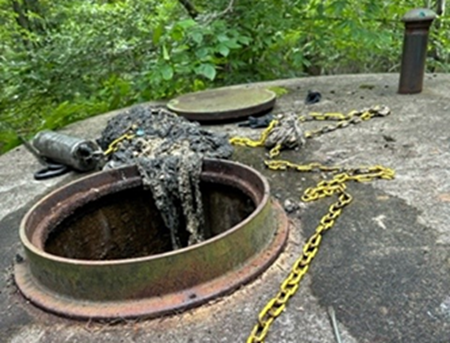
July 2023 - The cylinder to the left of debris is the bubbler, the device that that tells the pump when to come on, the rags and trash in the picture prevented an accurate measurement of the water level which did not trigger our alarm.
Here's how you can help
- Dispose of household items in the garbage.
- Keep fats, oils, grease from going down your sink drain and only flush toilet paper down the toilet.
- Do not flush diapers, rags and wipes – even if they say that they are flushable.
- Do not dispose of trash, pet waste, or dirty diapers on the beach and areas in and around the lake or near storm drains.
- Watch our short video here.
- Find out how to avoid costly clogs here.
- Find out more about what not to put down the drain here.
- Find out more about what not to flush here.
- If you think you see a leak or spill report it.
- If you think there is a water or wastewater problem contact Aqua at 877.987.2782, or by filling out our online form at https://www.aquawater.com/contact-us.php
- If you think that there is something being dumped into the storm drain, contact Virginia DEQ – Harrisonburg Valley Regional Office or call 540.574.7800
- Learn about your water and wastewater system - Attend our upcoming lunch-and-learns, LMOA Water Working Group meetings and check for project updates on our website.


Grease Trap Inspection Program
As business owners you can make sure your grease trap or interceptor is working correctly by making sure it is:
- Designed, sized and manufactured to handle the expected amount of grease.
- Installed properly, level and vented.
- Cleaned and serviced on a frequent basis.
Find out more about our Grease Trap Inspection Program here.
Water Main Flushing
Flushing a Water System's Pipelines is a common and necessary practice when maintaining a water distribution system. You can read more about water main flushing below.
2026 Lake Monticello Water System Flushing Schedule
Flushing will occur intermittently in targeted locations over a 7-week period.
- In each area, flushing may take 1–3 days, between 8:00 AM and 4:30 PM.
- Flushing will be limited to specific locations within each area; not all fire hydrants or flush points will be used.
- Aqua will monitor the drought status, river water levels, water storage, and water demand throughout this process and adjust the schedule as needed.
- Changes in schedule will be updated on the Disruption Map, and a WaterSmart Alert will be sent to customers in the applicable areas.
When Will Flushing Activities Take Place?
Flushing is scheduled intermittently between June 15, 2026 and July 31, 2026 in the Lake Monticello Water System.
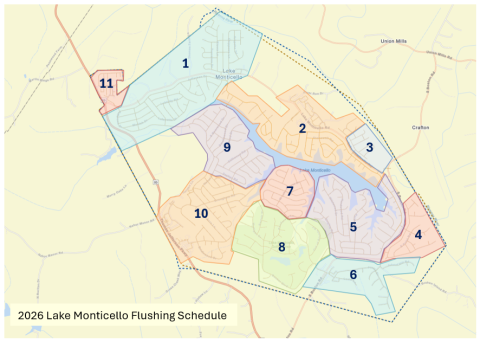
Flushing Status by Area as of 7/30/2026:
Flushing has been completed in all areas.
Flushing Notifications
- All planned flushing locations are listed on Aqua’s Disruption Map.
- Customers can search by address or click on the map to view planned hydrant and water main flushing activities.
- Customers should receive a WaterSmart Alert notification at least 3 days before flushing is scheduled in their area.
Tips when viewing Aqua’s Disruption Map
- The start date is June 12, 2026, which is when advisory notices were added to Aqua’s Disruption Map.
- The estimated end date is July 31, 2026, when the advisories will be removed from the map.
- Specific flushing dates for each area are listed at the top of the “Additional Details” section in each advisory. Example: “Planned flushing in this area is scheduled between 06/15/2026 and 06/17/2026.
The Disruption Map for Lake Monticello is currently very active.
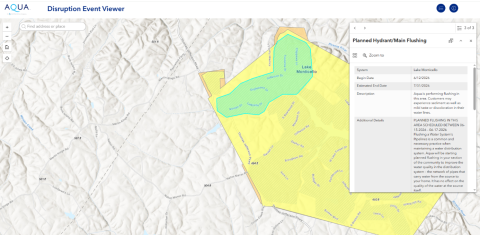
- There are at least three different advisory notification layers displayed on the Disruption Map across most of the Lake Monticello Water System.
- Customers should click on their address location on the map; the selected area will turn green/aqua.
- A notification message will appear. The “Conservation Advisory” should be the first message shown in the information box.
- At the top of the notification box, a counter (for example, “1 of 4” or “1 of 3”) will appear in the top-right corner. Clicking this will display all active advisories for that location.
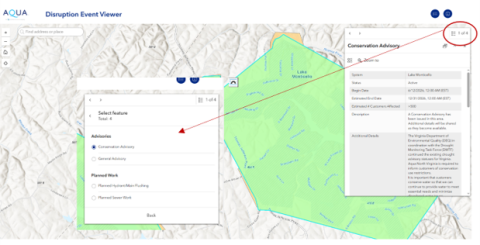
- Customers can view a specific advisory by clicking the small circle next to it. The circle will show a blue dot, and the advisory details will open in the information box.
Flushing During Drought Conditions
- Lake Monticello and Fluvanna County are currently in a Drought Warning stage. During this stage, the Virginia Department of Environmental Quality (DEQ) recommends voluntary water conservation. These efforts typically reduce water use by 5–10%.
- DEQ also encourages water utilities, such as Aqua, to voluntarily reduce or eliminate nonessential water use, including nonessential flushing of water lines.
- Some flushing is necessary to maintain water quality, especially during the hot summer months. With drought conditions in mind, flushing will follow a flushing plan over the course of a 7-week period.
Why is Water Main Flushing Needed?
Planned flushing helps improve water quality within the distribution system—the network of pipes that delivers water from the source to your home. However, it does not affect the quality of the water at the source itself.
The U.S. Environmental Protection Agency's (EPA) recommends flushing water system pipelines at least once a year, and more often in areas with known water quality issues, such as dead ends, or pipes that don't loop back through the system.
What This Means For Your Home
Flushing has little direct effect on the plumbing inside your home. Sediment can still build up in household pipes and on water heater elements over time, which is why we recommend periodically flushing your own plumbing as well.
It is worth noting that flushing can temporarily stir up sediment in the mains, which may briefly affect the water coming into your home. During scheduled flushing, minimize water use and avoid washing laundry. After flushing is complete, run an outdoor spigot for a few minutes to clear any sediment from the service line before it reaches your indoor plumbing.
What Flushing Does and Does Not Do
Flushing is used to maintain water quality in the distribution system – the network of pipes that carry water from the source to your home. It has no effect on the quality of the water at the source itself. If the source water contains elevated levels of iron and manganese, the water used during flushing will reflect that as well.
Flushing helps move accumulated minerals out of the distribution system. In doing so, it can stir up buildup, especially during high-flow events, which may lead to temporarily discolored water.
What to Expect During Water Main Flushing
Customers will be notified of service interruptions through a WaterSmart Alert and notification on Aqua’s Disruption Map for planned outages, and as soon as possible for unplanned outages. Once on our Disruption Map website, you may check the status of your water service by searching for your address or zooming in on the map.
Flushing could temporarily cause discolored water as it cleans out the pipes. We recommend that customers store sufficient water for cooking and drinking before flushing begins. We also recommend that you avoid doing laundry when system flushing is taking place since the minerals could cause staining, especially on light-colored items. You may experience low pressure and short water outages during the day of flushing.
After Aqua completes flushing for the day, we recommend that you consider removing and cleaning the aerators on your faucets. You may also consider flushing your water line by running the outside spigot for a few minutes to help purge any sediment before entering your household plumbing. If you have not done so recently, we recommend you flush your water heater in accordance with the manufacturer’s recommendations once all flushing activities have been completed.
Let's Stay Connected
- Give us your best contact info for our WaterSmart Alerts - email, text or phone (or all three!) Sign up at https://www.aquawater.com/watersmart-alerts
- You can share any feedback by calling 877.987.2782, or by filling out our online form at https://www.aquawater.com/contact-us
- If you are not satisfied with Aqua's response, customers may contact the State Corporation Commission by calling 800.552.7945 or by visiting their website at https://www.scc.virginia.gov.